Part Jobs, Only Able to Feed Family With Fast Food.
Fast food is a type of mass-produced food designed for commercial resale and with a strong priority placed on "speed of service" versus other relevant factors involved in culinary science. Fast food was created every bit a commercial strategy to arrange the larger numbers of busy commuters, travelers and wage workers who frequently did not have the time to sit down at a public house or diner and wait for their meal. By making the speed of service the priority, this ensured that customers with strictly express time (a commuter stopping to procure dinner to bring home to their family, for example, or an hourly laborer on a short dejeuner break) were non inconvenienced past waiting for their food to be cooked on-the-spot (as is expected from a traditional "sit downwardly" eating house). In 2018, the fast food industry was worth an estimated $570 billion globally.[1]
The fastest form of "fast food" consists of pre-cooked meals kept in readiness for a customer'southward inflow (Boston Market rotisserie craven, Footling Caesars pizza, etc.), with waiting fourth dimension reduced to mere seconds. Other fast food outlets, primarily the hamburger outlets (McDonald'south, Burger King, etc.) utilize mass-produced pre-prepared ingredients (bagged buns and condiments, frozen beef patties, vegetables which are prewashed, pre-sliced, or both; etc.) but the hamburgers and french fries are always cooked fresh (or at least relatively recently) and assembled "to society" (like at a diner).
Although a wide variety of food can be "cooked fast", "fast nutrient" is a commercial term-limited to food sold in a eating house or shop with frozen, preheated or precooked ingredients and served to the customer in a packaged form for have-out/take-abroad.
Fast nutrient restaurants are traditionally distinguished by their ability to serve food via a bulldoze-through. Outlets may exist stands or kiosks, which may provide no shelter or seating,[ii] or fast food restaurants (as well known as quick service restaurants).[3] Franchise operations that are function of restaurant chains have standardized foodstuffs shipped to each eating house from fundamental locations.[iv]
Fast food began with the beginning fish and chip shops in Uk in the 1860s.[ commendation needed ] Bulldoze-through restaurants were showtime popularized in the 1950s in the United States. The term "fast food" was recognized in a lexicon by Merriam–Webster in 1951.[ citation needed ]
Eating fast food has been linked to, amidst other things, cardiovascular disease, colorectal cancer, obesity, loftier cholesterol, insulin resistance conditions and low.[v] [half dozen] [seven] [eight] [9] Controlling for other diet and lifestyle confounders of fast food consumers oft doesn't attenuate these associations and it sometimes strengthens the clan betwixt fast nutrient consumption and mortality.[ten] Many fast foods tend to be loftier in saturated fatty, sugar, salt and calories.[xi]
The traditional family dinner is increasingly existence replaced by the consumption of takeaway fast food. As a result, the time invested on food preparation is getting lower, with an boilerplate woman in the Usa spending 47 minutes per day preparing food and the average man spending 19 minutes per mean solar day in 2013.[12]
History

Pulling wheat dough into thin strands to form lamian
The concept of set up-cooked food for sale is closely connected with urban developments. Homes in emerging cities often lacked acceptable space or proper food training accoutrements. Additionally, procuring cooking fuel could cost as much as purchased produce. Frying foods in vats of searing oil proved equally dangerous equally it was expensive. Homeowners feared that a rogue cooking fire "might easily conflagrate an entire neighborhood".[13] Thus, urbanites were encouraged to purchase pre-prepared meats or starches, such as bread or noodles, whenever possible. In Ancient Rome, cities had street stands – a large counter with a receptacle in the middle from which food or drink would have been served.[14] It was during post-WWII American economic boom that Americans began to spend more and buy more as the economy boomed and a civilization of consumerism bloomed. As a result of this new want to have it all, coupled with the strides made past women while the men were abroad, both members of the household began to work outside the habitation. Eating out, which had previously been considered a luxury, became a common occurrence, so a necessity. Workers, and working families, needed quick service and cheap food for both lunch and dinner.
Pre-industrial Former World
In the cities of Roman artifact, much of the urban population living in insulae, multi-story apartment blocks, depended on food vendors for much of their meal; the Forum itself served every bit a marketplace where Romans could buy broiled goods and cured meats.[15] In the mornings, staff of life soaked in wine was eaten as a quick snack and cooked vegetables and stews subsequently in popina, a unproblematic type of eating establishment.[sixteen] In Asia, twelfth century Chinese ate fried dough, soups and stuffed buns, all of which however exist as contemporary snack food.[17] Their Baghdadi contemporaries supplemented dwelling house-cooked meals with processed legumes, purchased starches, and even set-to-consume meats.[18] During the Middle Ages, large towns and major urban areas such as London and Paris supported numerous vendors that sold dishes such equally pies, pasties, flans, waffles, wafers, pancakes and cooked meats. Equally in Roman cities during artifact, many of these establishments catered to those who did not have ways to melt their own food, specially unmarried households. Unlike richer town dwellers, many ofttimes could non afford housing with kitchen facilities and thus relied on fast nutrient. Travelers such equally pilgrims en route to a holy site, were among the customers.[xix]
United Kingdom
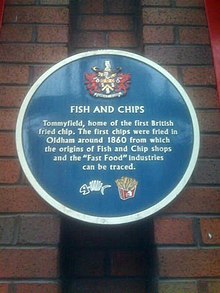
In areas with access to littoral or tidal waters, 'fast nutrient' frequently included local shellfish or seafood, such as oysters or, every bit in London, eels. Often this seafood was cooked direct on the quay or close past.[20] The development of trawler fishing in the mid-nineteenth century led to the evolution of a British favourite, fish and chips, and the first store in 1860.[21]

A blue plaque at Oldham's Tommyfield Market place marks the origin of the fish and chip shop and fast food industries.[21] As a inexpensive fast nutrient served in a wrapper, fish and chips became a stock meal amidst the Victorian working classes.[21] By 1910, in that location were more 25,000 fish and chip shops across the UK, and in the 1920s there were more than 35,000 shops.[22] Harry Ramsden's fast food restaurant chain opened its first fish and scrap shop in Guiseley, West Yorkshire in 1928. On a single 24-hour interval in 1952, the shop served 10,000 portions of fish and chips, earning a place in the Guinness Book of Records.[23]
British fast food had considerable regional variation. Sometimes the regionality of a dish became part of the culture of its respective area, such as the Cornish pasty and deep-fried Mars bar. The content of fast nutrient pies has varied, with poultry (such equally chickens) or wildfowl normally being used. Since the 2nd Earth War, turkey has been used more frequently in fast nutrient.[24] The United kingdom of great britain and northern ireland has adopted fast nutrient from other cultures likewise, such as pizza, doner kebab, and curry. More than recently, healthier alternatives to conventional fast food accept likewise emerged.
United States

As automobiles became popular and more affordable post-obit World War I, drive-in restaurants were introduced. The American company White Castle, founded past Billy Ingram and Walter Anderson in Wichita, Kansas in 1921, is mostly credited with opening the 2d fast food outlet and outset hamburger concatenation, selling hamburgers for 5 cents each.[25] Walter Anderson had built the first White Castle restaurant in Wichita in 1916, introducing the express carte du jour, high-volume, low-cost, loftier-speed hamburger eating place.[26] Among its innovations, the company allowed customers to see the food beingness prepared. White Castle was successful from its inception and spawned numerous competitors.
Franchising was introduced in 1921 past A&W Root Beer, which franchised its distinctive syrup. Howard Johnson's first franchised the restaurant concept in the mid-1930s, formally standardizing menus, signage and ad.[26]
Curb service was introduced in the belatedly 1920s and was mobilized in the 1940s when carhops strapped on roller skates.[27]
The Us has the largest fast nutrient industry in the globe, and American fast food restaurants are located in over 100 countries. Approximately 5.4 million U.S. workers are employed in the areas of food preparation and food servicing, including fast food in the US every bit of 2018.[28] Worries of an obesity epidemic and its related illnesses take inspired many local authorities officials in the United states of america to propose to limit or regulate fast-food restaurants. Yet, US adults are unwilling to change their fast food consumption even in the face of rising costs and unemployment characterized by the great recession, suggesting an inelastic demand.[29] However, some areas are more than affected than others. In Los Angeles Canton, for instance, about 45% of the restaurants in Due south Central Los Angeles are fast-food chains or restaurants with minimal seating. By comparison, only sixteen% of those on the Westside are such restaurants.[30]
Working conditions
The National Employment Constabulary Project wrote in 2013, "co-ordinate to a study by researchers at the Academy of California-Berkeley, more than half (52 pct) of front-line fast-food workers must rely on at to the lowest degree i public assist programme to support their families. As a result, the fast-food-manufacture business model of low wages, non-existent benefits, and limited work hours costs taxpayers an boilerplate of almost $7 billion every year". They claim this funding allows these workers to "beget wellness care, food, and other basic necessities".[31] [32]
On the become
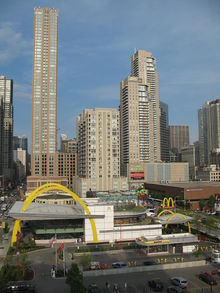
Fast food outlets are take-away or accept-out providers that promise quick service. Such fast nutrient outlets oft come with a "drive-through" service that lets customers club and pick up food from their vehicles. Others have indoor or outdoor seating areas where customers tin eat on-site. The boom in IT services has allowed customers to club nutrient from their homes through their smartphone apps in contempo times.
Well-nigh from its inception, fast food has been designed to be eaten "on the become," often does not require traditional cutlery, and is eaten as a finger food. Common carte du jour items at fast food outlets include fish and fries, sandwiches, pitas, hamburgers, fried craven, french fries, onion rings, chicken nuggets, tacos, pizza, hot dogs, and ice cream, though many fast food restaurants offer "slower" foods like chili, mashed potatoes, and salads.
Filling stations
Convenience stores located within many petrol/gas stations sell pre-packaged sandwiches, doughnuts, and hot food. Many gas stations in the United States and Europe too sell frozen foods, and have microwave ovens on the premises in which to prepare them. Petrol Stations in Australia sell foods such every bit hot pies, sandwiches, and chocolate bars, which are piece of cake for a customer to access while on their journey. Petrol stations are a place that are often open up long hours and are open before and afterwards store trading hours, therefore, it makes it easy to access for consumers.
Street vendors and concessions
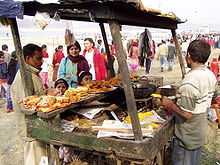
Street vendor serving fast food in Nepal

Traditional street food is available around the globe, usually through small and independent vendors operating from a cart, table, portable grill or motor vehicle. Mutual examples include Vietnamese rice soup vendors, Middle Eastern falafel stands, New York City hot canis familiaris carts, and taco trucks. Turo-Turo vendors (Tagalog for betoken betoken) are a feature of Philippine life. Commonly, street vendors provide a colorful and varying range of options designed to obsess passers-by and attract as much attention every bit possible quickly.
Multiple street vendors may specialize in specific types of nutrient; typically, they are characteristic of a given cultural or ethnic tradition depending on the locale. In some cultures, information technology is typical for street vendors to call out prices, sing or chant sales-pitches, play music, or engage in other forms of "street theatrics" to engage prospective customers. In some cases, this tin can garner more attention than the food.[ commendation needed ]
Cuisine

Modernistic commercial fast food is often highly candy and prepared in an industrial way, i.e., on a large scale with standard ingredients and standardized cooking and production methods.[33] It is ordinarily rapidly served in cartons or bags or in plastic wrapping, in a fashion that minimizes cost. In almost fast food operations, card items are mostly made from processed ingredients prepared at a central supply facility and and so shipped to individual outlets where they are reheated, cooked (usually past microwave or deep frying) or assembled in a short amount of fourth dimension. This procedure ensures a consistent level of production quality. It is key to being able to deliver the order quickly to the client and eliminate labor and equipment costs in the individual stores.
Because of commercial emphasis on quickness, uniformity and depression toll, fast food products are often fabricated with ingredients formulated to attain a certain flavor or consistency and to preserve freshness.
Variants

Many types of sushi ready to eat
Chinese takeaways/takeout restaurants are particularly popular in Western countries such equally the US and UK. They usually offer a wide diverseness of Asian food (non e'er Chinese), which has commonly been fried. Almost options are some form of noodles, rice, or meat. In some cases, the food is presented every bit a smörgåsbord, sometimes self service. The customer chooses the size of the container they wish to purchase, and so is complimentary to fill it with their choice of food. Information technology is common to combine several options in one container, and some outlets charge by weight rather than past item. In large cities, these restaurants may offer costless delivery for purchases over a minimum corporeality.
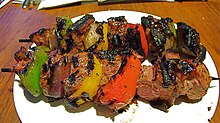
Sushi has seen speedily rising popularity recently in the Western world. A form of fast nutrient created in Nippon (where bentō is the Japanese variety of fast food), sushi is commonly common cold sticky rice flavored with a sweet rice vinegar and served with some topping (oft fish), or, as in the almost popular kind in the West, rolled in nori (dried laver) with filling. The filling oft includes fish, seafood, chicken or cucumber.
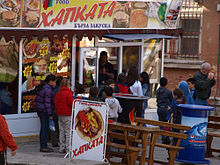
Pizza is a common fast food category in the United States, with nationwide chains including Papa John's, Domino's Pizza, Sbarro and Pizza Hut. It trails only the burger industry in supplying children's fast food calories.[34] Menus are more limited and standardized than in traditional pizzerias, and pizza delivery is offered.
Kebab houses are a form of fast food restaurant from the Heart Eastward, especially Turkey and Lebanon. Meat is shaven from a rotisserie, and is served on a warmed flatbread with salad and a option of sauce and dressing. These doner kebabs or shawarmas are singled-out from shish kebabs served on sticks. Kebab shops are besides found throughout the globe, especially Europe, New Zealand and Australia only they by and large are less common in the US.
Fish and scrap shops are a form of fast food popular in the Uk, Australia and New Zealand. Fish is battered then deep fried, and served with deep-fried white potato strips.[35]

The Dutch take their ain types of fast food. A Dutch fast food meal often consists of a portion of french fries (chosen friet or patat) with a sauce and a meat product. The most mutual sauce to accompany french fries is fritessaus. Information technology is a sweet, vinegary and low fat mayonnaise substitute, that the Dutch notwithstanding nevertheless call "mayonnaise". When ordering it is very often abbreviated to met (literally "with"). Other popular sauces are ketchup or spiced ketchup ("curry"), Indonesian style peanut sauce ("satésaus" or "pindasaus") or piccalilli. Sometimes the fries are served with combinations of sauces, virtually famously speciaal (special): mayonnaise, with (spiced) ketchup and chopped onions; and oorlog (literally "war"): mayonnaise and peanut sauce (sometimes as well with ketchup and chopped onions). The meat production is commonly a deep fried snack; this includes the frikandel (a deep fried skinless minced meat sausage), and the kroket (deep fried meat ragout covered in breadcrumbs).
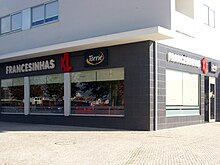

In Portugal, there are some varieties of local fast-food and restaurants specialized in this type of local cuisine. Some of the virtually popular foods include frango assado (Piri-piri grilled chicken previously marinated), francesinha, francesinha poveira, espetada (turkey or pork meat on 2 sticks) and bifanas (pork cutlets in a specific sauce served equally a sandwich). This blazon of food is too often served with french chips (called batatas fritas), some international bondage started appearing specialized in some of the typical Portuguese fast food such every bit Nando's.
An example of a local class of fast nutrient in Poland is pasztecik szczeciński, a deep-fried yeast dough stuffed with meat or vegetarian filling, typical fast food dish of the city of Szczecin well known in many other cities in the country. A dish is on Smoothen Listing of traditional products. The first bar serving pasztecik szczeciński, Bar "Pasztecik" founded in 1969, is located on Wojska Polskiego Avenue 46 in Szczecin.
A fixture of Due east Asian cities is the noodle shop. Flatbread and falafel are today ubiquitous in the Middle East. Popular Indian fast food dishes include vada pav, panipuri and dahi vada. In the French-speaking nations of West Africa, roadside stands in and effectually the larger cities continue to sell—as they have done for generations—a range of ready-to-eat, char-grilled meat sticks known locally as brochettes (not to be dislocated with the staff of life snack of the aforementioned name establish in Europe)
Business
In the U.s.a., consumers spent $160 billion on fast nutrient in 2012 (up from $six billion in 1970).[36] [37] In 2013, the U.s.a. eating place industry had total projected sales of $660.v billion.[38] Fast food has been losing market share to fast coincidental dining restaurants, which offer more robust and expensive cuisines.[39] Due to this competition, fast nutrient giants have seen dramatic drops in their sales.[xl] While overall fast food sales accept fallen, the number of Americans who consume in these restaurants "once a month or 'a few times a year'" has risen.[40]
In dissimilarity to the rest of the world, American citizens spend a much smaller corporeality of their income on food — largely due to various authorities subsidies that make fast food cheap and easily accessible.[41] Calorie for calorie, foods sold in fast food restaurants, costs less and is more energy-dense, and is made more often than not of products that the government subsidizes heavily: corn, soy, and beef.[42]
The Australian fast nutrient market is valued at more than than ii.7 billion GPB and is equanimous of 1.four billion fast nutrient meals. This includes meals serviced at 17,000 fast nutrient outlets. The fast food market has experienced an average annual growth rate of six.5 percent, which is the most rapidly growing sector of the retail food marketplace.[43]
Ad
In 2012, fast food restaurants spent roughly US$four.6 billion on advertising campaigns, which represented an eight% increase from 2009. In the aforementioned period of time, McDonald'southward spent nearly three times as much on advertisement as all water, milk, and produce advertisers spent combined.[44]
A study done by researchers from the Geisel School of Medicine at Dartmouth College saw results that suggest that when children lookout more commercial television receiver (and see more than advertisements on fast food), they are more inclined to ask to visit these subsequent fast nutrient restaurants.[45] Specifically, fast food restaurants have been increasing their advertising efforts that target Blackness and Hispanic youth.[46] A 2021 report from the Rudd Center for Food Policy & Obesity indicated that fast-nutrient restaurants spent almost $318 million on Spanish-language TV channels. The same study found that fast-nutrient restaurants spent about $99 1000000 on majority Black viewer TV channels. Black youth groups viewed fast-food advertisements about more than white youth groups.[47] Advertising on Spanish speaking channels increased by 8% in 2012, with KFC and Burger King increasing spending in this demographic by 35% while cut downward on their regular advertisement within English speaking channels.[ citation needed ]
The Quango of Ameliorate Business Bureaus started the Children's Food and Beverage Advertising Initiative in 2006 which asked fast food companies to pledge to "advertise only more healthful products to children" with McDonald's and Burger Rex signing on.[45] Even so, despite a slight increment in healthful food advertising, the effectiveness of this initiative has been disputed past studies that reveal that "children couldn't remember or place healthful foods in the ads, and that 81 percent of the 99 three to 7 year olds in that study recalled French fries" fifty-fifty though there were no French fries in the advertisement.[48]
Employment
According to the U.S. Bureau of Labor Statistics, about 4.one meg U.S. workers are employed in food grooming and serving (including fast food) as of 2010.[28] The BLS's projected job outlook expects average growth and splendid opportunity as a result of high turnover. However, in April 2011, McDonald'south hired approximately 62,000 new workers and received a one thousand thousand applications for those positions—an acceptance rate of half-dozen.2%.[49] The median age of workers in the industry in 2013 was 28.[l] Obtaining Human Resource Management diploma or diploma in Fast Food Management can assistance to become a job in major fast nutrient restaurants since it is one of the about desired.[51] The employment rate for Australians working in the fast nutrient manufacture is increasingly loftier, with 17% of people working inside the fast food sector in Australia.[ citation needed ]
Globalization


In 2006, the global fast-food marketplace grew by iv.8% and reached a value of £102.iv billion and a volume of lxxx.3 billion transactions.[52] McDonald'southward alone, has outlets in 126 countries on 6 continents and operates over 31,000 restaurants worldwide.[53]
One example of McDonald's expansion on a global scale was its introduction to the Russian market. In lodge for the American business to succeed it would have to exist accepted and integrated into the daily lives of natives in Moscow. Thus, the eating place was strategically implemented so that its offerings would marshal with the singled-out and established eating habits, too known as the community around food, eating and cooking, of Muscovites. I significant feature of Russian nutrient culture is the emphasis on knowing nigh the locality of appurtenances that are consumed. Substantially, in club to successfully launch this American make in a foreign country, McDonald's interpreted the local interests of consumers in Moscow by promoting the origins of the produce used in the restaurant.[54] On January 31, 1990, McDonald's opened a restaurant in Moscow and bankrupt opening-day records for customers served. The Moscow eating house is the busiest in the world.
The largest McDonald's in the world, with 25,000 feet of play tubes, an arcade and play middle, is located in Orlando, Florida, The states[55] [ clarification needed ]
There are numerous other fast food restaurants located all over the globe. Burger Male monarch has more than than 11,100 restaurants in more than than 65 countries.[56] KFC is located in 25 countries.[57] Subway is one of the fastest growing franchises in the world with approximately 39,129 restaurants in 90 countries as of May 2009,[58] the first non-United states of america location opening in December 1984 in Bahrain.[59] Wienerwald has spread from Germany into Asia[60] and Africa.[61] Pizza Hut is located in 97 countries, with 100 locations in China.[62] Taco Bong has 278 restaurants located in fourteen countries besides the United States.[63]
Criticism
Fast-nutrient chains have come under criticism over concerns ranging from claimed negative health effects, alleged animal cruelty, cases of worker exploitation, and claims of cultural degradation via shifts in people's eating patterns away from traditional foods.[64] [65] [66] [67] [68] [69] [70] [71] [72] [73] [74] [75] [76] [77]
The intake of fast nutrient is increasing worldwide. A written report done in the metropolis of Jeddah has shown that current fast-nutrient habits are related to the increment of overweight and obesity amongst adolescents in Kingdom of saudi arabia.[78] In 2014, the World Health Organization published a study which claims that deregulated nutrient markets are largely to blame for the obesity crunch, and suggested tighter regulations to contrary the trend.[79] In the United States, local governments are restricting fast food chains past limiting the number of restaurants plant in certain geographical areas.[fourscore]
To combat criticism, fast-food restaurants are starting to offering more than wellness-friendly bill of fare items.[81] In add-on to health critics, in that location are suggestions for the fast-food industry to go more than eco-friendly. The bondage have responded by "reducing packaging waste".[81]
Although trying to overcome criticism through healthy options on fast food menus, Marion Nestle, who serves as the chair of New York University'south Department of Nutrition and Food Studies, suggests that fast-food industries intentionally market place unhealthy foods to children through advertising options and therefore create customers for life.[82]
Despite and so much popularity, fast foods and fast-food bondage have adverse impacts not only on the task and social skills, but on the health and academic operation of students. L-six percentage of students consume fast food on a weekly basis.[83] The researcher who wrote Fast Food Nation, Eric Schlosser, highlights this fact, arguing that this is not merely a fiscal merely too a psychological allurement, in that the students are lured towards this early on employment opportunity knowing little that the fourth dimension spent on this no-skill-learning job is wasted.[84] Ii other researchers, Charles Hirschman and Irina Voloshin, highlight their dangerous impacts and consequences regarding the hiring and firing of teenage schoolhouse-goers in the fast-food industry.[85] Kelly Brownwell of The Atlantic Times has further supported this argument that Burger King and McDonald's adopted some other unsafe exercise for marketing to innocent children.[86]
In a inquiry written report conducted by Professors Purtell Kelly and Gershoff, they found that the students of fifth grades, who ate fast foods as compared to the students of the same age later some other social factors were controlled.[ clarification needed ] Also, the percentage of the students having consumed fast food and showed poor grades was around 11 pct more than than those who used organic foods. They are of the view that other social factors such as television watching, video games and playing were controlled to assess the real impacts of fast foods.[87]
There have been books and films, such every bit the 2004 flick Super Size Me, designed to highlight the potential negative health effects from the overconsumption of fast food such every bit its contribution to obesity.[88]
Run across also
- Fast food in Mainland china
- Fast Food Song
- Food group
- Junk food
- List of fast food restaurant chains
- List of pizza chains
- List of restaurant terminology
- Lists of foods
- National Middle for Wellness Statistics
- Panic Nation
- Slow Food
- Snack
- Super Size Me
- TV dinner
- Western design diet
References
- ^ "Fast Food Industry Assay 2018 – Cost & Trends". franchisehelp.com. Franchise Help. 2018. p. one. Retrieved July xvi, 2019.
- ^ Jakle, John (1999). Fast Food: Roadside Restaurants in the Automobile Age . Johns Hopkins University Press. ISBN978-0-8018-6920-4. ; Brueggemann, Walter (1993). Texts Nether Negotiation: The Bible and Postmodern Imagination . Fortress Press. ISBN978-0-8006-2736-2.
- ^ "Quick Service Restaurants (QSR) Market Worth USD 577.71 Billion past 2028 at three.65% CAGR – Report by Market Enquiry Futurity (MRFR)". GlobeNewswire. August 18, 2021. Retrieved August 26, 2021.
- ^ Talwar, Jennifer (2003). Fast Food, Fast Track: Immigrants, Big Business organisation, and the American Dream. Westview Press. ISBN978-0-8133-4155-2.
- ^ "The link between fast food and depression has been confirmed". EurekAlert! . Retrieved Apr 22, 2018.
- ^ Pietrangelo, Ann; Carey, Elea. "xiii Effects of Fast Nutrient on the Trunk". Healthline . Retrieved March xx, 2016.
- ^ "Susan Cohan Colon Cancer Foundation: Prevention: Eating Well/Diet". coloncancerfoundation.org. Archived from the original on October 18, 2016. Retrieved August 16, 2016.
- ^ Publications, Harvard Health. "Red meat and colon cancer – Harvard Health". Retrieved August 16, 2016.
- ^ Bao, Wei; Tobias, Deirdre K.; Olsen, Sjurdur F.; Zhang, Cuilin (December 1, 2014). "Pre-pregnancy fried food consumption and the take chances of gestational diabetes mellitus: a prospective cohort report". Diabetologia. 57 (12): 2485–2491. doi:10.1007/s00125-014-3382-x. ISSN 1432-0428. PMC4221538. PMID 25303998.
- ^ Pan, An; Malik, Vasanti; Hu, Frank B. (July 10, 2012). "Exporting Diabetes to Asia: The Impact of Western-Style Fast Nutrient". Circulation. 126 (two): 163–165. doi:x.1161/CIRCULATIONAHA.112.115923. ISSN 0009-7322. PMC3401093. PMID 22753305.
- ^ Hellesvig-Gaskell, Karen. "Definition of Fast Foods | LIVESTRONG.COM". LIVESTRONG.COM . Retrieved May 3, 2016.
- ^ Jaworowska, Agnieszka; Blackham, Toni; Davies, Ian G.; Stevenson, Leonard (May i, 2013). "Nutritional challenges and health implications of takeaway and fast nutrient" (PDF). Nutrition Reviews. 71 (v): 310–318. doi:ten.1111/nure.12031. ISSN 0029-6643. PMID 23590707.
- ^ Laudan, Rachel (2001). "A Plea for Culinary Modernism: Why Nosotros Should Love New, Fast, Processed Nutrient". Gastronomica: The Journal of Disquisitional Food Studies. 1: 36–44. doi:x.1525/gfc.2001.one.1.36.
- ^ "Ancient Romans preferred fast food". ABC Scientific discipline. June 19, 2007. Retrieved June 30, 2016.
- ^ Dupont, Florence (1992). Daily Life in Ancient Rome. Oxford: Blackwell. p. 181.
- ^ Stambaugh, John Due east. (1988). The Ancient Roman City. JHU Press. pp. 200, 209. ISBN978-0-8018-3692-three.
- ^ Chang, Kwang-chih (1977). Nutrient in Chinese Culture: Anthropological and Historical Perspectives. New Haven: Yale University Printing.
- ^ Le Strange, G. (1924). Baghdad during the Abbasid Caliphate from Contemporary Arabic and Persian Sources, 81–82. London: Oxford Academy Press. pp. 81–82.
- ^ Carling, Martha (2003). Food and Eating in Medieval Europe. Bloomsbury Academic. pp. 27–51. ISBN978-1-85285-148-4.
- ^ BBC (August 31, 2006). "Eel and pie store". BBC. Retrieved Nov 24, 2007.
- ^ a b c Webb, Andrew (2011). Food Britannia. Random Firm. p. 397.
- ^ Alexander, James (December 18, 2009). "The unlikely origin of fish and chips". BBC News . Retrieved July 16, 2013.
- ^ "Harry Ramsden's famous original fish and chip shop faces closure after losses". The Guardian. Retrieved January six, 2018
- ^ BBC News (February seven, 2007). "How turkey became a fast nutrient". BBC. Retrieved November 23, 2007.
- ^ National Public Radio (2002). "The Hamburger". NPR. Archived from the original on Dec 22, 2007. Retrieved November 23, 2007.
- ^ a b James P Farrell. "The Evolution of the Quick Service Restaurant". A Direction Consultant @ Large. Retrieved February fourteen, 2008.
- ^ Mcginley, Lou Ellen (2004). Honk for Service, a Man, a Tray, and the Glory Days of the Drive-in. Tray Days Publishing. ISBN978-0-615-12697-v.
- ^ a b "BLS.gov: Food and Potable Serving and Related Workers". December 17, 2015. Retrieved April half dozen, 2016.
- ^ Smith, Lindsey P.; Ng, Shu Wen; Popkin, Barry Thousand. (May ane, 2014). "Resistant to the recession: low-income adults' maintenance of cooking and abroad-from-home eating behaviors during times of economic turbulence". American Periodical of Public Health. 104 (5): 840–846. doi:10.2105/AJPH.2013.301677. ISSN 1541-0048. PMC3987573. PMID 24625145.
- ^ Tami Abdollah (September x, 2007). "A strict order for fast food". Los Angeles Times.
- ^ "Super-Sizing public costs: How Depression Wages at Top Fast-Food Bondage Exit Taxpayers Footing the Pecker" (PDF). National Employment Law Project. October 2013. Archived from the original (PDF) on May 5, 2015. Retrieved May 22, 2015.
- ^ Maclay, Kathleen (October 15, 2013). "Fast Nutrient, Poverty Wages: The Public Toll of Low-wage jobs in the Fast Food Manufacture" (PDF). University of California Labor Centre.
- ^ Monteiro, C.A.; Moubarac, J.-C.; Cannon, M.; Ng, South.West.; Popkin, B. (2013). "Ultra-processed products are becoming dominant in the global nutrient organisation". Obesity Reviews. xiv Suppl two: 21–8. doi:x.1111/obr.12107. PMID 24102801. S2CID 13735684.
- ^ Rehm, Colin D.; Drewnowski, Adam (2014). "A New Method to Monitor the Contribution of Fast Food Restaurants to the Diets of United states of america Children". PLOS 1. nine (7): e103543. Bibcode:2014PLoSO...9j3543R. doi:10.1371/journal.pone.0103543. PMC4111613. PMID 25062277.
- ^ "Federation of Fish Friers – Serving the Fish and Chips Industry – History". Retrieved May 24, 2015.
- ^ "Fast Nutrient Industry Analysis 2015 – Cost & Trends". Retrieved May 24, 2015.
- ^ Schlosser, Eric (2001). Fast Food Nation: The Night Side of the All-American Meal . Houghton Mifflin Books. ISBN978-0-395-97789-7.
- ^ "NRA Pocket Factbook" (PDF). National Restaurant Association. 2013. Archived from the original (PDF) on March four, 2016. Retrieved April 6, 2016.
- ^ John Eligon (January xiii, 2008). "Where to Eat? A New Restaurant Genre Offers Manhattan More Choices". The New York Times . Retrieved December 30, 2008.
Though still a relatively small sector within the nation's $350 billion eatery industry, several fast-casual chains are showing success and growth in Manhattan, and industry experts say it could be a sign of the sector'south maturity and sustainability nationwide.
- ^ a b Kiener, Robert. "Food Policy Debates". CQ Researcher.
- ^ "Commodity Policy and Agricultural Subsidies". Yale Rudd Center for Food Policy and Obesity. Jan i, 2013. Retrieved August xviii, 2014.
- ^ Parker-Pope, Tara (December 5, 2007). "A High Cost for Salubrious Food". The New York Times . Retrieved August 17, 2014.
- ^ Cameron Allan; Greg J. Bamber; Nils Timo (September 1, 2006). "Fast‐food work: are McJobs satisfying?". Employee Relations. 28 (five): 402–420. doi:ten.1108/01425450610683627. ISSN 0142-5455.
- ^ University, Yale. "Fast Nutrient FACTS — Fast Food Facts in Brief". www.fastfoodmarketing.org . Retrieved April xviii, 2017.
- ^ a b Dell'Antonia, KJ. "More than Research Suggests Fast-Nutrient Advertising Works on Children". Motherlode Web log. The New York Times. Retrieved April 18, 2017.
- ^ "Report: Ascension in fast-food advertising largely targets Black, Hispanic youths". UPI . Retrieved June 17, 2021.
- ^ Harris, Jennifer L., Frances Fleming-Milici, Lindsay Phaneuf, Melissa Jensen, Yoon Young Choi, Melissa McCann, Sally Mancini. Fast food advertisement: Billions in spending, connected high exposure by youth
- ^ Bernhardt, Amy M.; Wilking, Cara; Gottlieb, Marking (May 2014). "Children's Reaction to Depictions of Healthy Foods in Fast-Food Idiot box Advertisements". JAMA Pediatrics. 168 (v): 422–426. doi:10.1001/jamapediatrics.2014.140. PMID 24686476. Retrieved April 20, 2017.
- ^ "Information technology's Harder To Become A Task At McDonald's Than It Is To Get Into Harvard". Business Insider. Apr 28, 2011. Retrieved May 24, 2015.
- ^ Owens, Christine (Baronial 29, 2013). "Trying to raise a family on a fast-food salary". Reuters. Archived from the original on Baronial 31, 2013. Retrieved April viii, 2016.
- ^ "Fast Food Chore Applications".
- ^ "Our Life Policy Research Notes on takeaways – The UK fast-food marketplace" (PDF). Archived from the original (PDF) on January 14, 2013. Retrieved July 28, 2012.
- ^ "The Fast Food Mill".
- ^ Caldwell, Melissa L. "Domesticating the French Fry: McDonald'due south and Consumerism in Moscow." Journal of Consumer Civilisation 4.i (2004): five–26. Spider web. January 30, 2017.
- ^ "Globe's Largest McDonald's in Orlando, FL". Retrieved May 24, 2015.
- ^ "Burger Male monarch".
- ^ "KFC".
- ^ Subway publication (2008). "Official SUBWAY Restaurants Spider web Site". Subway Restaurants. Retrieved May 24, 2009.
- ^ "Subway".
- ^ "Wienerwald – Türkiye – Restoranlar". Archived from the original on May 23, 2015. Retrieved May 24, 2015.
- ^ "WIENERWALD – Restaurants in Egypt". Retrieved May 24, 2015.
- ^ "Yum! Brands".
- ^ "Taco Bell".
- ^ Jeffery, Robert (January 25, 2006). "Are fast nutrient restaurants an environmental risk factor for obesity?". International Journal of Behavioral Nutrition and Physical Activity. iii: 2. doi:10.1186/1479-5868-3-2. PMC1397859. PMID 16436207.
- ^ Freeman, Andrea (December 6, 2007). "Fast Food: Oppression through Poor Nutrition". California Police Review. 95 (6): 2221–2259. JSTOR 20439143.
- ^ Ronald, Adams (September eight, 2008). "Fast Food and Animal Rights: An Examination and Assessment of the Manufacture's Response to Social Pressure". Business and Social club Review. 113 (3): 301–328. doi:10.1111/j.1467-8594.2008.00322.10. S2CID 154438433.
- ^ Singer, Peter and Bricklayer, Jim. "The Ethics of What We Eat: Why Our Nutrient Choices Thing". Holtzbrink Publishers. 2006.
- ^ Vocalist, P (1975). Animal liberation. ISBN978-0-394-40096-ix.
- ^ Schlosser, Eric. Fast Food Nation: The Nighttime Side of the All-American Meal. Harper Collins Publishers. 2001
- ^ Smith, Vicki (November 4, 1998). "The Fractured Globe of the Temporary Worker: Power, Participation, and Fragmentation in the Contemporary Workplace". Social Problems. 45 (four): 411–430. doi:ten.2307/3097205. JSTOR 3097205.
- ^ Duffey, Kiyah (January 2007). "Differential associations of fast food and restaurant food consumption with 3-y change in torso mass index: the Coronary Artery Take chances Development in Young Adults Study". The American Journal of Clinical Nutrition. 85 (1): 201–8. doi:10.1093/ajcn/85.one.201. PMID 17209197. Retrieved Apr 8, 2016.
- ^ French, Simone (May 2001). "Environmental Influences on Eating and Physical Activity". Annual Review of Public Health. 22: 309–35. doi:10.1146/annurev.publhealth.22.1.309. PMID 11274524.
- ^ James F. Sallis, Karen Glanz. "The Part of Built Environments in Physical Activity, Eating, and Obesity in Childhood". The Future of Children Book 16, Number 1, Spring 2006 pp. 89–108 | 10.1353/foc.2006.0009. [1]
- ^ Walshe, Sadhbh. "How America's fast food industry makes a quick buck. The gulf between CEO pay and staff McWages is shockingly broad: a strike serves this system of super-exploitation right". April 10, 2013 [2]
- ^ Michelle M. Mello, Eric B. Rimm and David M. Studdert. "The McLawsuit: The Fast-Food Manufacture And Legal Accountability For Obesity". Health Affairs. November 2003. vol. 22 no. half-dozen 207–216. [3].
- ^ Shanthy A. Bowman, Steven L. Gortmaker, Cara B. Ebbeling, Marking A. Pereira, David S. Ludwig. "Effects of Fast-Nutrient Consumption on Free energy Intake and Diet Quality Among Children in a National Household Survey". Pediatrics Vol. 113 No. Jan i, one, 2004 pp. 112–118 [4]
- ^ Hossein Rouhani, Mohammad; Mirseifinezhad, Maryam; Omrani, Nasrin; Esmaillzadeh, Ahmad; Azadbakht, Leila (2012). "Fast Food Consumption, Quality of Diet, and Obesity among Isfahanian Adolescent Girls". Periodical of Obesity. 2012: 597924. doi:ten.1155/2012/597924. PMC3352603. PMID 22619703.
- ^ A. Washi, Sidiga; Maha B. Ageib (2010). "Poor diet quality and nutrient habits are related to impaired nutritional condition in 13- to 18-year-old adolescents in Jeddah". Nutrition Inquiry. 30 (eight): 527–34. doi:10.1016/j.nutres.2010.07.002. PMID 20851306.
- ^ Written report finds deregulation fuelling obesity epidemic. Reuters. February two, 2014. Retrieved March 6, 2014.
- ^ Nixon, Laura; Mejia, Pamela; Dorfman, Lori; Cheyne, Andrew; Young, Sandra; Friedman, Lissy C.; Gottlieb, Mark A.; Wooten, Heather. "Fast-Food Fights: News Coverage of Local Efforts to Improve Nutrient Environments Through State-Utilize Regulations, 2000–2013". American Journal of Public Health. Mar2015, Vol. 105 Result 3, p490-496. 7p. two Charts, 2 Graphs.
- ^ a b Clark, Charles Due south. "Fast-Nutrient Shake-Up". CQ Researcher.
- ^ Nestle, Marion (2002). Food Politics: How the Food Manufacture Influences Nutrition and Health. Berkeley: Academy of California Press. ISBN9780520955066.
- ^ Hilger, J., Loerbroks, A. and Diehl, K., 2017. Appetite, 109, pp.100–107. (2017). "Eating behaviour of university students in Frg: Dietary intake, barriers to healthy eating and changes in eating behaviour since the time of matriculation". Appetite. 109: 100–107. doi:x.1016/j.appet.2016.11.016. PMID 27864073. S2CID 3626607 – via Elsevier Science Directly.
{{cite journal}}: CS1 maint: multiple names: authors listing (link) - ^ Schlosser, Eric. Fast Nutrient Nation. The Night Side of All American Meals. Mariner Books. New York. 2012. Print.
- ^ Hirschman, Charles, and Irina Voloshin. "The Construction of Teenage Employment: Social Background and the Jobs Held by Loftier Schoolhouse Seniors." Inquiry in social stratification and mobility 25.iii (2007): 189–203. National Center for Biotechnology Data. Spider web. November 13, 2015.
- ^ Brownwell, Kelly. "Are Children Prey for Fast Food Companies?" The Atlantic. The Atlantic. November 8, 2008. Web. November thirteen, 2015.
- ^ Purtell, K. K.; Gershoff, Eastward. T. (2014). "Fast Food Consumption and Academic Growth in Late Childhood". Clinical Pediatrics. 54 (nine): 871–77. doi:10.1177/0009922814561742. PMID 25480321. S2CID 25605019.
- ^ Brindal, Emily; Mohr, Philip; Wilson, Carlene; Wittert, Gary (July 1, 2008). "Obesity and the furnishings of choice at a fast food eatery". Obesity Inquiry & Clinical Do. ii (ii): 111–117. doi:x.1016/j.orcp.2008.03.004. ISSN 1871-403X. PMID 24351729.
Farther reading
- Adams, Catherine (2007). "Reframing the Obesity Debate: McDonald's Role May Surprise You". Journal of Police force, Medicine and Ethics. 35 (i): 154–157. doi:ten.1111/j.1748-720X.2007.00120.ten. PMID 17341224. S2CID 42933273.
- Arndt, Michael. "McDonald's 24/7." Business organisation Week February iv, 2007
- Food and Eating in Medieval Europe. Martha Carlin and Joel T. Rosenthal (editors). The Hambledon Press, London. 1998. ISBN i-85285-148-1
- Hogan, David. Selling 'em past the Sack: White Castle and the Creation of American Food. New York: New York University Press, 1997.
- Kroc, Ray with Robert Anderson. Grinding It Out: The Making of McDonald's. St. Martin's Printing, 1992.
- Levinstein, Harvey. Paradox of Plenty: a Social History of Eating in Modern America. Berkeley: University of California P, 2003. 228–229.
- Luxenberg, Stan. Roadside Empires: How the Chains Franchised America. New York: Viking, 1985.
- McGinley, Lou Ellen with Stephanie Spurr, Honk for Service: A Man, A Tray and the Glory Days of the Drive-In. St. Louis: Tray Days Publishing, 2004. For photos of the Parkmoor Restaurants see Drive-In Eating place Photos
- Pollan, M. (2009). In Defense of Food: an Eater'south Manifesto. New York Urban center: Penguin
- Schlosser, Eric, Fast Nutrient Nation: The Dark Side of the All-American Meal, Houghton Mifflin Company, 2001
- Schultz, Howard with Dori Jones Yang, Pour Your Eye Into It: How Starbucks Built a Company One Cup at a Fourth dimension, Hyperion, 1999
- Warner, Melanie "Salads or No, Inexpensive Burgers Revive McDonald's." The New York Times April 19, 2006.
External links
Source: https://en.wikipedia.org/wiki/Fast_food

Post a Comment for "Part Jobs, Only Able to Feed Family With Fast Food."